

Let me ask you something.
When you think of rosé, what comes to mind?
If your brain went straight to pale pink, Provence, a pool, and a bottle of Whispering Angel – you’re not alone. That’s what rosé has become in the American market. Light, pretty, inoffensive. A category defined more by its aesthetic than by what’s actually in the glass.
I used to be the same way. For me it was something I had in the summer only, and it could only have a whisper of pink. That’s all.
But then I moved to Puglia. And everything changed.
(Full disclosure: I’ve written about my personal Whispering Angel reckoning before – you can read that here. But this post is about the bigger picture – why the entire category of Apulian rosé deserves a second look, not just one bottle.)
Rosé in Puglia Is Not What You Think It Is
The first thing to understand is that Apulian rosé is built on a completely different grape than its French counterpart.
In Provence, the primary grapes used are Grenache, Cinsault, and Mourvèdre – varieties that, when pressed for rosé, produce that famous barely-there blush. Delicate. Subtle. Designed to be pale.
In Puglia, the base is almost always Negroamaro – and Negroamaro does NOT do subtle.
Negroamaro translates, literally, to “black and bitter.” It’s a grape with presence – deep color, bold dark fruit, a savory edge that most rosé grapes simply don’t have. When you make rosé from it, something interesting happens: you get a wine that has real depth without the weight of a full red, serious food-friendliness without being heavy, and a color that runs anywhere from copper to deep salmony pink. Sometimes almost orange, if it gets a little bit older.
It doesn’t look like a Provence rosé. It doesn’t taste like one either. But that’s entirely the point.
The Flavor Profile Is Built for Food
Here’s where Apulian rosé really separates itself from the pack – and where it becomes genuinely interesting for anyone who wants to try something that’s entirely unforgettable.
Provence rosé was essentially designed to be sipped. It’s a wine for warm weather, light snacks, good company. It’s not really built to sit next to a serious plate of food and hold its own. Think backyard happy hours, or beachside in an ice bucket.
Apulian rosé? Food is exactly what it’s designed for.
The Negroamaro base gives it a dry, almost savory profile — there’s grapefruit and pomegranate and dried cherry on the fruit side, yes, but there’s also a mineral quality (something coastal, almost briny) and that characteristic bitter finish that makes it incredibly versatile at the table. It can handle grilled fish. It can sit next to a plate of aged pecorino. It can bridge the gap between antipasto and a meat course without getting lost.
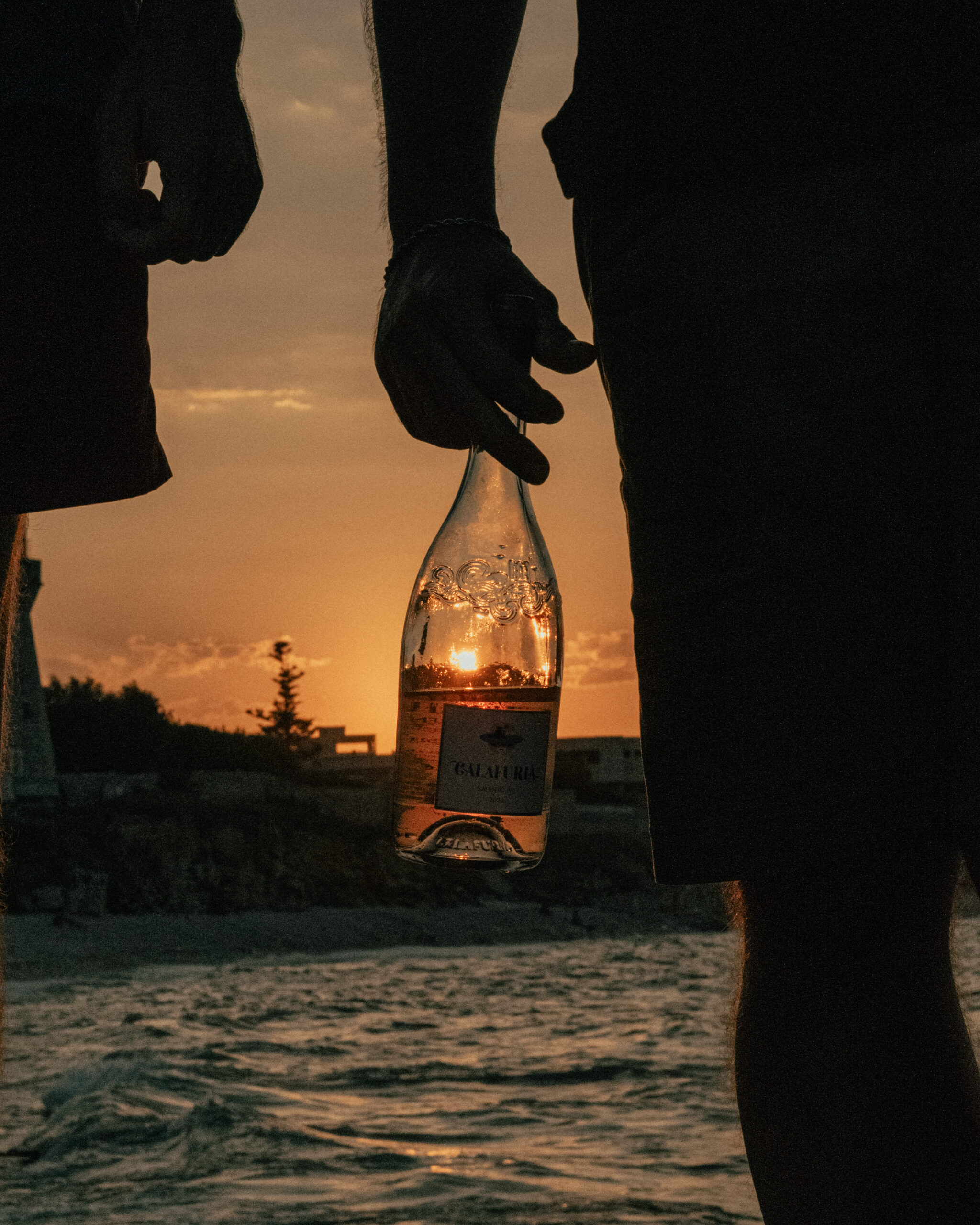
And here’s a detail I love: it’s genuinely the wine I’d choose for an Italian aperitivo over almost anything else. There’s a reason Calafuria – a Negroamaro rosé from Tormaresca in Puglia – became my go-to aperitivo pour when I lived there. If you want to understand the whole aperitivo ritual and why the wine choice matters so much, I wrote about that here.
The Color Tells You Something
This might sound small, but stay with me.
In the American market, pale rosé became so dominant that a lot of consumers started equating paleness with quality. The paler the better. The more translucent, the more refined.
Apulian rosé will absolutely fail that test – and that’s a compliment, not a ding.
The deeper color in a Negroamaro rosé comes from longer skin contact during winemaking. That contact is what gives the wine its body, its savory mineral character, its staying power in the glass. A pale Provençal rosé has been pressed immediately and minimally.
An Apulian rosé has had time to actually BECOME something.
Why This Matters in a Place Like Miami
I’ve been in Miami for a couple of weeks now, and what I’ve learned is that it has one of the most sophisticated rosé cultures in the country. Warm weather, waterfront dining, a clientele that travels and drinks well. Rosé is not a hard sell here.
But the rosé conversation has been pretty one-note for a long time. Pale, Provençal, predictable.
Apulian rosé is a genuinely exciting alternative – and it’s still early enough that putting it on a wine list feels like a discovery rather than an obvious choice. It offers restaurants a way to differentiate their program, start a conversation at the table, and introduce guests to a category of wine that most of them have never encountered.
The price point also tends to be significantly more favorable than equivalent-quality Provençal bottles. Which, as any wine director will tell you, matters.
Where to Start
If you want to explore Apulian rosé and you need a starting point, Calafuria by Tormaresca is the bottle I always come back to first – grapefruit, pomegranate, a little lavender on the nose, and that grounding cedar edge that makes it feel complete. It’s Negroamaro done beautifully, and I LOVE that you can actually find it here in the States. I wrote a full breakdown of that one here if you want the longer version.
Beyond that, look for anything from Leone de Castris — their “Five Roses” is one of the most historically significant rosés in all of Italy, period. And A-Mano makes a reliably food-forward, approachable Negroamaro rosato that punches well above its price point.
The Bottom Line
Apulian rosé isn’t trying to be Provence. It’s not pale, it’s not subtle, and it’s not designed for poolside sipping on its own. Even though, like I said – I HAVE been known to have a glass or two seaside.
It’s a wine with a point of view – one that comes from a place with ancient vines, brilliant sunshine, and a food culture that demands its wine show up ready to work. If you’ve only ever experienced rosé as a warm-weather aesthetic, this might actually change your mind about the category.
Start with a bottle. Pair it with something good. Take your time with it. That’s exactly how they’d do it in Puglia.